Quality service since 1995



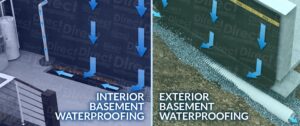
As a homeowner, one of the most basic and important things to do to protect the health of your family and the value of your home is solving wet basement problems. If left unchecked, a wet basement poses a great health risk to your family and also to the value of your property. Basement moisture not only ruins walls and floors but also encourages the growth of moulds and bacteria thus causing damages to your home. A wet basement feels and smells very nasty as well.
There are many basement treatment options available if your home is suffering from damp, pooled water, or if you require a preventative measure against future water damage.
Water damage can come in many different forms, and can have a number of causes. When water pools against the outside of your home, it can eventually find its way in through the walls. Hydrostatic pressure from soil and water can push damp through into your basement. Severe rainfall and floods can cause water to enter at weak points.
Exterior waterproofing treatments are one of the main ways you can permanently solve your wet basement. This method tends to be much more costly, as it requires a lot of work, such as excavation on the outside of your home, but the results are fantastic.
The main exterior wet basement treatment utilizes waterproofing membranes, which are applied to the outside walls of the property to stop water from entering. French drains are then installed, which channel the blocked water away from your home.
The exterior waterproofing treatment will leave the inside home completely free from any water, and provide the maximum structural benefits for your property. It is a lifelong solution that will add value to your home, as well as making sure it always stays dry.
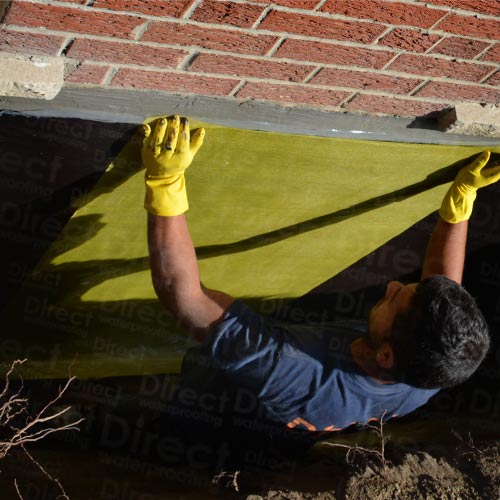
As well as the main exterior wet basement treatment, you might find that you can address water damage problems from the outside of your home in a number of ways.
Window Wells:
Window wells can often be a place where water can build up and leak into your basement. This can happen if the well is badly designed, or the drainage damaged or blocked. Unblocking drainage and installing new window wells can help to stop water pooling.
French Drains:
French drains are usually installed as part of the main exterior wet basement treatment, but can also be used as a separate treatment when water pools in your yard or against your home.
Grading:
If the grading around your home allows water to collect in certain areas, especially against your foundations, then proper grading may be an appropriate treatment.
Fix the Leakage:
If you are in a financially able position to fix the problem permanently then you should do it. First, you need to know what is causing the leakage. If you can hire the services of experts to come and take a look at your house, they will evaluate the problem then offer you solid wet basement waterproofing solutions that will suite your needs. It might be that your rain gutters are worn out or your downspouts are not working properly— whichever the case, an expert will be best suited to help you out and give you more information.
Checking for Runoffs:
Runoffs normally happen when rainwater or melted snow that is not routed away from the house percolates through porous top soil. Surface water around your compound should be directed away from the house. When it percolates around, it seeps down and rests near the building. The water is then forced through the cracks in walls and footings by hydrostatic pressure. It may also infiltrate down porous walls through capillarity action. You should look for ways in which runoffs are likely to end up in your basement. This can be done by checking if the gradient slope from your house is causing water to clog or if the driveway curbs are not properly channelling away runoffs.
You may want to get wet basement solutions and start patching cracks in the foundation and sealing walls of your basement.
Investigating on Subsurface Sources:
If your basement is consistently wet, you might be dealing with a case of high ground water. If wet basements don’t dry up after a storm, you should check with your local county or town office so that you know if water table in that area is unusually high or if underground springs are a common thing. You might want to consider the opinion of an expert on this.
A wet basement can be such a nuisance especially if yours includes a furnished and living space. It might ruin your drywall, framing and even carpeting, leaving you to deal with the losses. Even if your basement is used for storage and other insignificant uses, it needs proper care and maintenance. Direct Waterproofing offers wet basement solutions and other services if you are having such problems with your basement.
Another effective type of wet basement treatment, and a hugely popular option for a lot of homeowners. Interior wet basement treatments tend to be very cost effective and accessible, and provide great water control that keeps damp and wet pools away from your basement.
Most interior wet basement treatments are actually water control methods, which carry water via drainage systems rather than actually block the water. These include the installation of drainage systems, and perhaps sump pump systems.
The full interior waterproofing method involves the use of delta membranes or cavity walls against your inside basement walls, in order to allow water to drain out of your foundation walls and into an integrated drainage system.
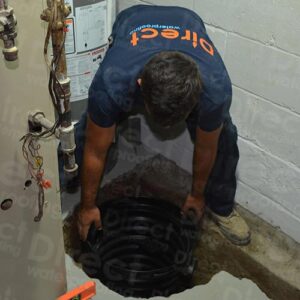
As well as the full interior waterproofing treatment, you may find the following beneficial as individual treatments.
Sump Pumps:
Sump pumps make an excellent solution if your home comes under damage from very heavy rainfall or flooding, and can deal with even extreme situations. The treatment ensures the water is pumped away from your home.
Drainage:
Weeping tiles and french drains are often used as interior wet basement treatments. They are contained in a trench under the floor, and safely carry water away.
Foundation Crack Repair:
This is a big one for anyone who is serious about keeping their basement dry. Cracks and gaps can form in foundations as a home settles, or due to pressure from soil and water. Repairing these cracks is crucial to keeping water out, and keeping your home stable and sturdy. Hydraulic cement or epoxy resin can be applied to the cracks.
With so many offers on how to treat a wet basement, how do you know which one if right for you? A professional evaluation will certainly help to clarify this. Sometimes the problem is really obvious, such as a leak through a window well. The solution will therefore be to fix the window well.
However, there will often be several options available to treat a wet basement, depending on your preferences and intentions. For example, you might opt for an interior solution in order to deal with a water damage problem quickly and cost effectively, or you might choose an exterior one to permanently rectify all dampness in your foundations.


